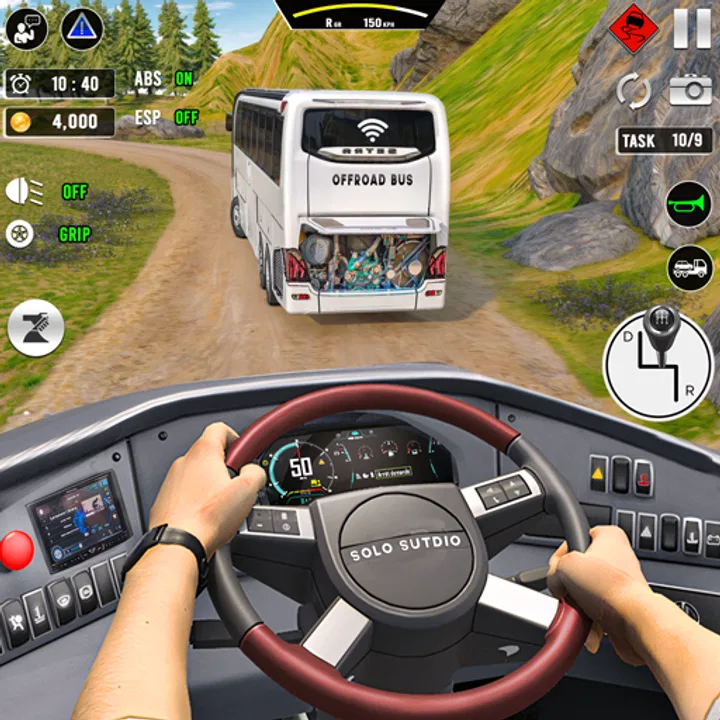
Real Bus Simulator : Bus Games
- 3.4
- Rating
- 50.00M
- Installs
- Free
- Price
 Analysis by App-foxy
Real Bus Simulator : Bus Games is the kind of strategy game I open when I want a simple driving session rather than a complicated management system. I spend the time steering a coach bus, following roads, handling turns, and trying to keep each trip under control. That sounds straightforward, and it is, but the appeal comes from turning ordinary driving actions into a small test of patience and planning. It is free to play, aimed at Everyone, and developed by Solo Studio Inc, so it is easy to approach even if you have never played a bus simulator before.
After using it, I see a clear audience for this game: players who enjoy casual vehicle challenges, short sessions, and learning through repetition. It is less convincing for someone looking for a detailed transport-management game, realistic public-transit operations, or a large simulation with deep customization. The driving focus is the important thing here. You are not buying into a complex city-building experience; you are practicing the rhythm of moving a large vehicle through routes without losing control.
How the driving loop feels in everyday play
My usual session starts with a simple goal: drive carefully enough to finish the route instead of treating the bus like a small car. That distinction matters. A coach bus needs more room for turns, more time to slow down, and more attention when the road changes direction. The first few attempts are mostly about building that sense of scale. I learned quickly that rushing into a bend creates more trouble than arriving a little late or taking a wider line.
You May Also Like

 Blood Strike: 2.5 Anniversary
Blood Strike’s Loadouts Turn Every Drop Into a Tactical Gamble
A close look at Blood Strike’s custom loadouts: how fast access to signature weapons reshapes its battle royale rhythm, rewards preparation, and narrows the gap between fights.

 Pandora - Music & Podcasts
Pandora’s Music Is Easy to Start, but Harder to Recover
Pandora’s strength is its low-effort path from a seed to a station. Its weak spot is how much confidence it asks you to place in connection, setup, and quiet recovery.

 8 Ball Pool
 Is Built on Rivalries, Rematches, and Routine
A close look at the rivalries, rematches, shared routines, and unanswered safety questions that turn a quick pool match into a persistent mobile community.

 Samsung Music
’s Quiet Strength Is Playing What You Already Own
Its reach comes less from spectacle than from dependable access to a personal library. That simplicity is both the app’s strongest retention engine and its ceiling.

 AccuWeather: Weather Radar
AccuWeather Review: A Quick, Clear Forecast for Everyday Decisions
For everyday plans, the best forecast is the one you can understand quickly. AccuWeather makes rain timing, radar, and local conditions easy to act on, with a few trade-offs.

 Hill Climb Racing
Why Hill Climb Racing Still Turns Crashes Into One More Run
A tiny car, a bumpy hill and one more upgrade: Hill Climb Racing keeps resurfacing because its simple chaos makes every near-miss feel personal.
More From Our News Desk
View All News


The basic workflow is easy to understand. I choose a driving session, get familiar with the road ahead, and concentrate on steering, speed, and positioning. The game’s store summary describes it as a way to drive a coach bus and learn bus-driving skills in a three-dimensional setting, and that description matches the central experience without needing extra complexity. The challenge is not discovering a huge number of systems; it is making better decisions during the drive.
That makes the game useful for short breaks. I can play for a few minutes, focus on one route, and stop without feeling that I have abandoned a long campaign. It also works as a low-pressure introduction to the simulator category. Someone who has never handled a bus game can understand the purpose almost immediately, while a more experienced player can use repeated attempts to improve smoothness and control.
One realistic use case is a commute or lunch break when I want something interactive but not mentally exhausting. I would not choose it when I need a deep strategy session with layered resource decisions. I would choose it when I want to relax, practice careful movement, and enjoy the small satisfaction of completing a route cleanly.
The most important habit is to treat every corner as a planning problem. Before turning, I reduce speed early rather than braking sharply in the middle of the bend. I also leave more space than feels necessary, especially when the road narrows. This is not a flashy technique, but it prevents the common mistake of correcting too late. The best improvement comes from smoother preparation, not faster reactions.
Why repetition helps more than rushing
At first, repeating a route can feel basic, but repetition gives the game its modest strategic layer. I start noticing where I tend to turn too early, where I carry too much speed, and which sections make me overcorrect. Instead of seeing a failed attempt as wasted time, I use it to identify one specific mistake. On the next run, I change only that habit. That approach is more effective than trying to drive faster and fix everything at once.
I also recommend beginning with a calm mindset. If I treat the bus like an arcade racer, the experience becomes frustrating because the vehicle does not respond like a small sports car. If I accept slower steering and longer stopping distances, the controls become easier to read. This is one of the game’s better teaching qualities, even when the presentation remains relatively simple.
Settings that deserve attention before a serious session
I always check the available control and presentation options before settling into a longer run. In a bus simulator, control comfort can matter more than visual detail. A steering method that feels natural to one player may feel awkward to another, so I spend a few minutes testing how the bus responds to directional input. That small setup step can prevent unnecessary corrections later.
I also keep the display clear enough to read the road. A busy screen can make it harder to judge a bend or notice a change in direction, particularly when I am concentrating on the vehicle’s position. I prefer a view that lets me see the bus and the road together rather than focusing too closely on one part of the vehicle. The right viewpoint is personal, but the practical rule is simple: choose the view that helps you plan the next movement.
Sound is worth adjusting to taste as well. I find that a moderate audio level helps me stay aware of the drive without making the session tiring. Players who prefer a quiet experience can lower it and focus visually. I would not treat sound as a gameplay advantage, but it can affect how comfortable a longer session feels.
Because the game is free, I also pay attention to the way optional spending fits into my play. The listed in-app purchase price is $2.99 per item. I would not spend immediately. I first decide whether the basic driving loop holds my attention, then consider whether an optional purchase genuinely improves my experience. For a casual game built around repeated driving, delaying purchases is a sensible way to avoid paying for content before knowing how often you will return.
The game is available for devices running Android 6.0 or later, which makes it accessible to many older phones and tablets. Even so, compatibility is not the same as comfort. On a smaller or less powerful device, I would close other apps, keep the screen clean, and avoid judging the game during a moment when the phone is already struggling. Smooth control is especially important here because small delays can make a turn feel harder than it should.
Small routines that make each attempt cleaner
Experienced play in this game is less about secret shortcuts and more about using the same reliable routine every time. Before moving, I take a moment to understand the immediate road direction. During the drive, I keep speed under control before a corner rather than waiting until the bus is already turning. After a mistake, I avoid making several emergency corrections in a row. I slow down, regain a stable line, and continue from there.
Another useful pattern is to separate steering from speed management. When I try to turn and brake aggressively at the same time, the bus becomes harder to predict. I get better results by reducing speed first, then steering with smaller movements. This is a simple trade-off: the route may take longer, but the chance of losing control is lower. In a game centered on bus driving, consistency is usually more valuable than a risky time-saving move.
I also use repeat attempts deliberately. On the first run, I focus on learning the route. On the second, I focus on braking points. On the third, I try to make the steering smoother. This gives each attempt a purpose and stops the game from becoming a vague cycle of failure and retrying. It is a practical method that works particularly well for players who like gradual improvement rather than instant mastery.
When playing on a phone, I keep my hands positioned so that I can make small adjustments without covering important parts of the screen. I avoid gripping too tightly because that encourages exaggerated movements. If a control feels sensitive, I make shorter inputs and pause between corrections. These habits are not special features; they are ways of getting more predictable results from the controls that are already there.
For a relaxed daily session, I would set a modest target such as completing one route with fewer mistakes than the previous attempt. That goal is more enjoyable than demanding a perfect performance immediately. It also makes the game suitable for younger players within its Everyone rating, provided they understand that the main lesson is patience rather than speed.
Where the strategy becomes more demanding
Although this belongs to the strategy category, the strategy is closely tied to driving decisions rather than broad planning. I am choosing when to slow down, how wide to take a turn, and how to respond when the road asks for more control. Players expecting staff management, fuel planning, route economics, or a detailed transit network may find the strategic scope limited. A dedicated transport-management title would be a better choice for that kind of experience.
The same limitation applies to realism. The three-dimensional presentation supports the driving fantasy, but this is still a mobile game designed for accessible play. I would not approach it as professional driver training or as a complete replacement for a serious simulator. Its value is in practicing cautious movement inside a game, not in reproducing every responsibility of operating a real coach service.
I also think the game can become repetitive for players who need constant novelty. The core actions remain familiar: steer, manage speed, follow the road, and complete the drive. That repetition is satisfying when I am in the mood to refine a habit, but it may feel thin if I want frequent changes in objectives or a large number of interconnected systems. Before installing, ask yourself whether repeating a familiar driving loop sounds relaxing or boring.
The average rating is 3.2 from around forty-seven thousand ratings, while the game has passed fifty million installs. I read that combination as a useful warning against assuming broad popularity guarantees a perfect fit. Many people have tried it, but the middling average suggests that expectations may vary. I would recommend judging it by the driving loop and control style rather than by the install count alone.
What the current version means for a new player
The current version is 6.0, and the game was released on August 28, 2023. For someone installing it now, the practical question is not how long the game has existed but whether its focused format matches what they want today. I would begin with the free experience, test several sessions, and pay attention to whether the controls become more comfortable with practice.
I would recommend it to a player who enjoys bus-themed games, wants an approachable driving challenge, or likes improving through repetition. It is also a reasonable choice for someone who prefers games that can be understood quickly without reading a long manual. The Everyone content rating makes it broadly approachable, although individual preferences about driving difficulty and optional purchases still matter.
I would suggest skipping it if you want a highly detailed simulation of a real bus company, a competitive multiplayer environment, or a strategy game built around financial decisions. I would also skip it if you dislike repeating routes to improve small control errors. In those cases, a deeper management game or a more technically demanding simulator would likely provide better long-term satisfaction.
One question many new players have is whether they need to spend money to understand the game. My advice is no: start free and decide based on the basic driving experience. Since purchases are offered at $2.99 per item, I would treat them as optional extras rather than part of the entry requirement. The sensible workflow is to learn the controls first, identify what you actually enjoy, and only then consider spending.
Another practical question is whether an older device can run it. The minimum operating-system requirement is Android 6.0, so the software threshold is not especially demanding by modern standards. Still, I would keep expectations realistic on older hardware and prioritize a stable, comfortable session over maximum visual settings. If the controls feel delayed, the problem may be the device environment rather than your driving technique.
My verdict after settling into the routine
Real Bus Simulator : Bus Games works best when I approach it as a focused casual strategy game, not as a complete transport simulator. Its strongest quality is the clear driving loop: I can start quickly, practice careful bus handling, and see improvement when I stop rushing. The experience rewards planning corners, managing speed early, and repeating a route with one concrete adjustment in mind.
Its weaknesses are equally clear. The narrow focus may not satisfy players who need deep management systems or constant variety, and the moderate average rating suggests that the experience will not suit everyone who downloads it. Optional purchases also deserve a measured approach, especially for anyone who is still deciding whether repeated bus driving is enjoyable.
For me, the game earns a recommendation for casual players who like patient vehicle challenges. I would install it before paying for anything, adjust the controls to feel natural, and use short repeat sessions to build consistency. If you enjoy turning a simple route into a small exercise in timing and control, this free bus game is worth trying; if you want a full-scale transit simulation, choose a deeper alternative instead.
That is ultimately where I place it: an accessible, specific driving game with a modest strategic layer and a useful learning curve. It does not need to pretend to be more than that. When I want a quick bus-driving session and have the patience to improve gradually, it gives me a straightforward reason to play.
FAQs for Real Bus Simulator : Bus Games
01What are the main features of Real Bus Simulator: Bus Games?
Real Bus Simulator: Bus Games offers a realistic driving experience with detailed bus interiors, dynamic weather conditions, and a variety of routes and cities to explore. Users can enjoy high-quality graphics and an intuitive control system. The game also provides a career mode, allowing players to manage routes and grow their bus company.
02Is Real Bus Simulator: Bus Games free to play?
Yes, Real Bus Simulator: Bus Games is free to download and play. However, it may include in-app purchases for additional content, such as premium buses, customization options, or unlocking certain features faster. Players can choose to make these purchases to enhance their gameplay experience.
03Does Real Bus Simulator: Bus Games require an internet connection?
While Real Bus Simulator: Bus Games can be played offline, certain features might require an internet connection. For instance, accessing daily challenges, updates, or certain multiplayer modes could need connectivity. It's always best to check the specific requirements on the app store page before downloading.
04What are the system requirements for Real Bus Simulator: Bus Games?
Real Bus Simulator: Bus Games is available for both Android and iOS devices. For Android, a device with at least 2GB of RAM and Android version 5.0 or higher is recommended. For iOS, it typically requires iOS 10.0 or later. Ensuring your device meets these specifications will help the game run smoothly.
05How often are updates and new content added to the game?
The developers of Real Bus Simulator: Bus Games frequently update the app to provide bug fixes, performance improvements, and new content. Updates may include new routes, buses, and features. It's advisable to enable automatic updates on your device to enjoy the latest enhancements and content as soon as they are released.
Pros
- Realistic bus physics enhance gameplay.
- Wide variety of routes and locations.
- Detailed interiors for immersive experience.
- Customizable buses and liveries.
- Dynamic weather conditions add variety.
Cons
- Some routes can feel repetitive.
- Occasional frame rate drops in busy areas.
- Limited passenger interaction options.
- In-app purchases can be expensive.
- Ads may interrupt gameplay sessions.

Real Bus Simulator : Bus Games
Gallery